
If there’s one aspect of American culture that helps spread the word about dude ranches, it’s movies. Dude ranching as a business had been around since 1882, but it took nearly forty years for filmmakers — also creating a new industry — to see the potential of these places.
At first, dude ranches were just locations for western-type stories or a place for actors to stay. In 1918, Larry Larom and Winthrop Brooks, owners of The Valley Ranch outside of Cody, heard that the studio making the film The Hell Cat was coming to the area. So they invited the cast and crew to stay at the ranch, though the filming was done elsewhere. Star Geraldine Farrar, who was also an opera singer, did not care for the rustic life, however. In her memoir she described the whole experience as “discomfort and irritation.” She was thrilled when she got back on the train for New York.
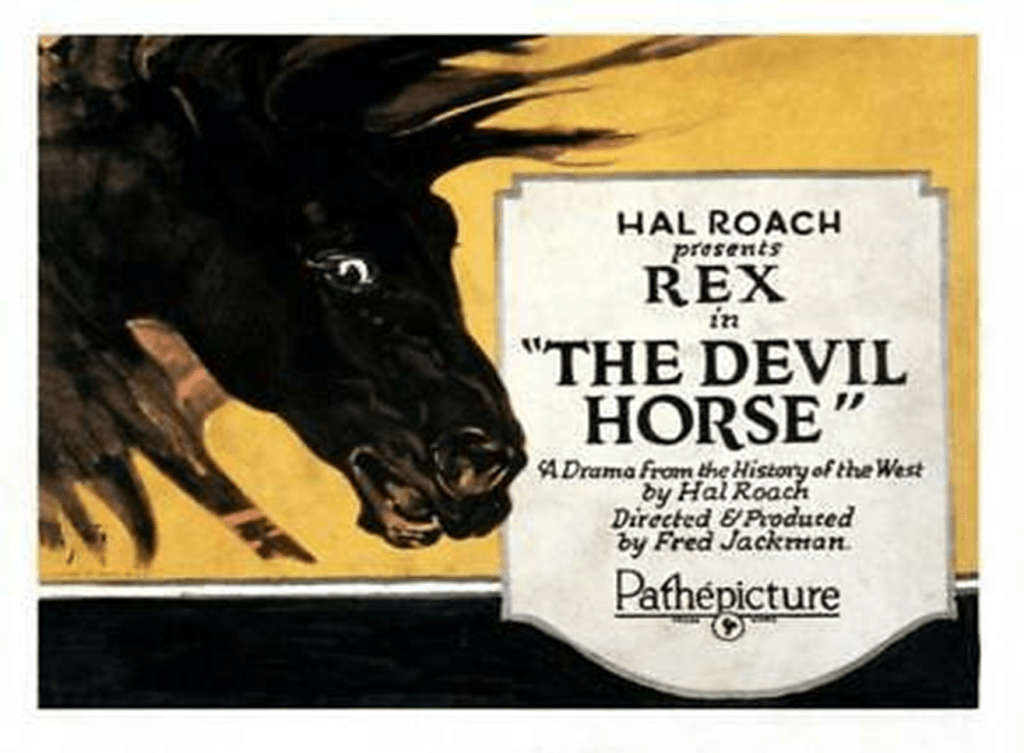
In the summer of 1925 Hal Roach’s production company also showed up in Cody, to film The Devil Horse, starring the world’s greatest stunt man, Yakima Canutt. The movie was shot at the Morris Ranch about eighteen miles west of Cody, which took in a few dudes now and then. Having the actors around did a lot to raise its profile.
The first film to feature dude ranches as an actual topic was Wrangling Dudes, from 1919. It was part of a series of travelogues called “Outing Chester” films, a collaboration between Outing magazine and producer Clarence L. Chester. It was filmed in Montana and apparently featured many dude activities. I say apparently, because I’ve never been able to track down a copy. So, it might be a “lost silent” film. But at least we have the newspaper ads.

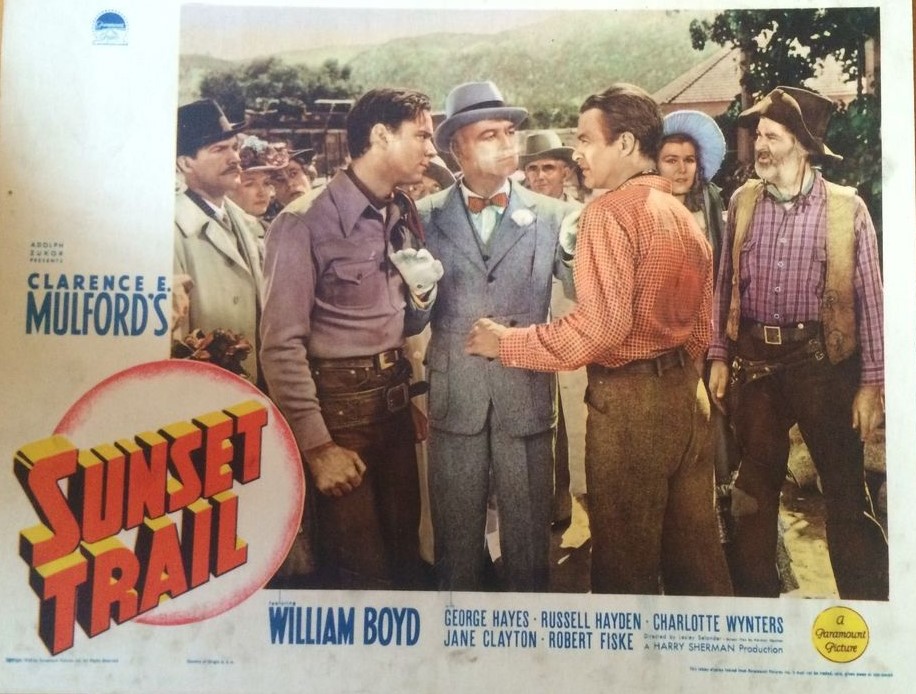
By 1930, films were incorporating the dude ranch as a plot point. Dude Ranch from 1930, is based on a novel by Milton Krims, who went on to be a major screenwriter. Then, the famous character Hopalong Cassidy made a dude-themed movie, Sunset Trail, in 1939. He had to pretend to be a dude in order to help the ranch owner solve a murder.
There’s even a Citizen Kane/dude ranch connection. In 1940, Orson Welles sent screenwriter Herman Mankiewicz to the North Verde dude ranch near Victorville, California to write the first draft of the film. The movie, of course, is about publishing magnate William Randolph Hearst.
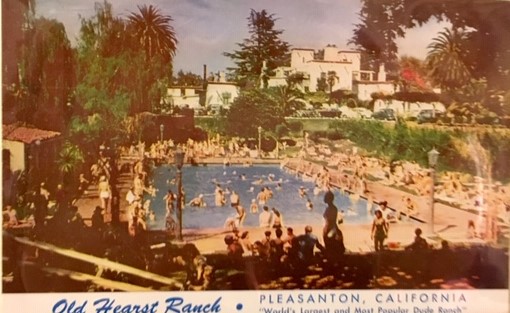
His father, miner turned millionaire George Hearst, owned a piece of property in Pleasanton, about forty miles east of San Francisco, where he had a hunting lodge. After his death in 1891 his widow Phoebe added to the property and turned it into one of her homes. When she passed in 1919, son William kept the place, but then moved many of the antique furnishings to his grand home in San Simeon. He sold the property in 1924 to a group of investors who turned it into the Castlewood Country Club.
Around 1940 the property was remade as a dude ranch called the Old Hearst Ranch. It was always full and even had its own radio show called “The Dude Ranch Breakfast.” Sold again in 1952, the ranch went through a few more owners, and is today The Club at Castlewood.
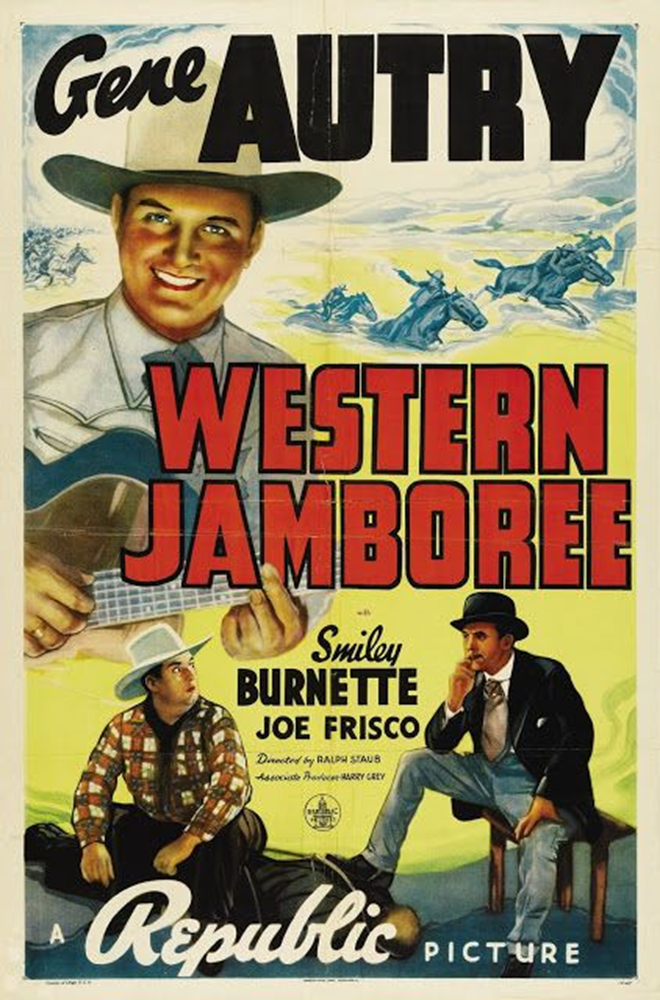
Singing cowboy Gene Autry included dude ranches in many of his films. Sometimes they were just a place to move the main story along, and give him a chance to sing to a group of dudes: In Old Santa Fe, Western Jamboree, Heart of the Rio Grande, and Oh, Susanna!
Two Guys from Texas debuted in 1948, a buddy movie with Jack Carson and Dennis Morgan. They play a musical duo whose car breaks down near a Texas dude ranch, so they sing for their room and board and help lovely owner Dorothy Maguire solve a crime on the ranch.

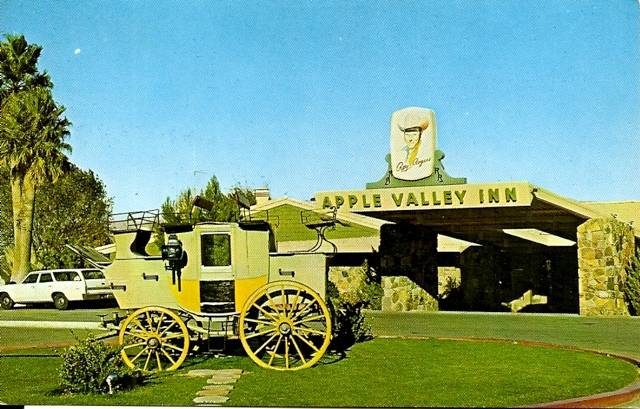
By the 1950s dude ranching had returned to being just a location setting: like 1955’s Foxfire, starring Jane Russell and Jeff Chandler. Russell met Chandler at the “La Paz Guest Ranch,” which was actually the Apple Valley Inn in Victorville.
Spencer’s Mountain, filmed at the Triangle X dude ranch in Moose, Wyoming, came out in 1962, and when the movie premiered in Jackson Hole, the ranch got a bump in reservations.
Dude ranching’s popularity went up and down depending on tourism trends and its appearance either in film or television. Though ranches mostly disappeared from movie screens, they did show up in the plots of 1970s series like Happy Days and Charlie’s Angels.
Then, in 1980, a movie debuted that changed the way Americans looked at cowboys: Urban Cowboy. It gave a huge boost to western clothing, music, and not surprisingly, dude ranching.

This was the headline in the March 24, 1981 issue of the Flagstaff Arizona Daily. The article praised the film for bringing more dudes and dudines to Arizona ranches (not to mention Montana and Wyoming). The craze continued for a few more years and then began to fade.
But movies came to the rescue of dude ranches again in 1991. I’m sure you know which one I’m talking about.

When I was was writing my book, American Dude Ranch: A Touch of the Cowboy and the Thrill of the West, people asked me if I was going to write about City Slickers. That’s so interesting, because it isn’t a dude ranch movie at all. It’s a cattle drive movie.
Even the guy who owns the ranch says so at the beginning of the film: “If you came here thinkin’ this is a dude ranch, I hate to disappoint you. This is not pretend. This is a real workin’ ranch.” There are some dude ranch elements when the three guys show up: they try to buy western wear and appropriate headgear, and fail at horseback riding and roping. They are definitely dudes.
But here’s the thing. The characters in every dude ranch movie share the same trajectory: when they get to the ranch they are awkward easterners looking for a cowboy experience, or at a crossroads in their lives. Or both. By the time they leave the ranch, they have changed, they’ve been transformed by the West. They take their experience with them into new, and better lives.
That’s why I love these movies. The dude ranch is a place not only to find the West, but to find yourself.
Now, there’s another movie genre that also involves the dude ranch, but it’s a very specific type: the Reno divorce ranch. That’s a story for my next post.


Yay! I love getting these blog posts.
LikeLike
Thanks, Rachel!
LikeLike
Love it!!!
Thanks,
<
div>Joan
Sent from my iPhonejoanbrown7@comcast.net415-516-2880
<
div dir=”ltr”>
<
blockquote type=”cite”>
LikeLike
Thanks, Joan!
LikeLike
Thanks for another interesting post, Lynn! I am looking forward to your next one.
LikeLike
Thanks, Janet!
LikeLike