
In 2019, the McCracken Research Library at the Buffalo Bill Center of the West in Cody, Wyoming awarded me a Resident Fellowship to study their (amazing) dude ranch archives for my book, American Dude Ranch: A Touch of the Cowboy and the Thrill of the West. I flew to Cody in August and spent a week among the boxes. I was in heaven. The documents, photographs, and artifacts were pure gold, and the staff was wonderful.
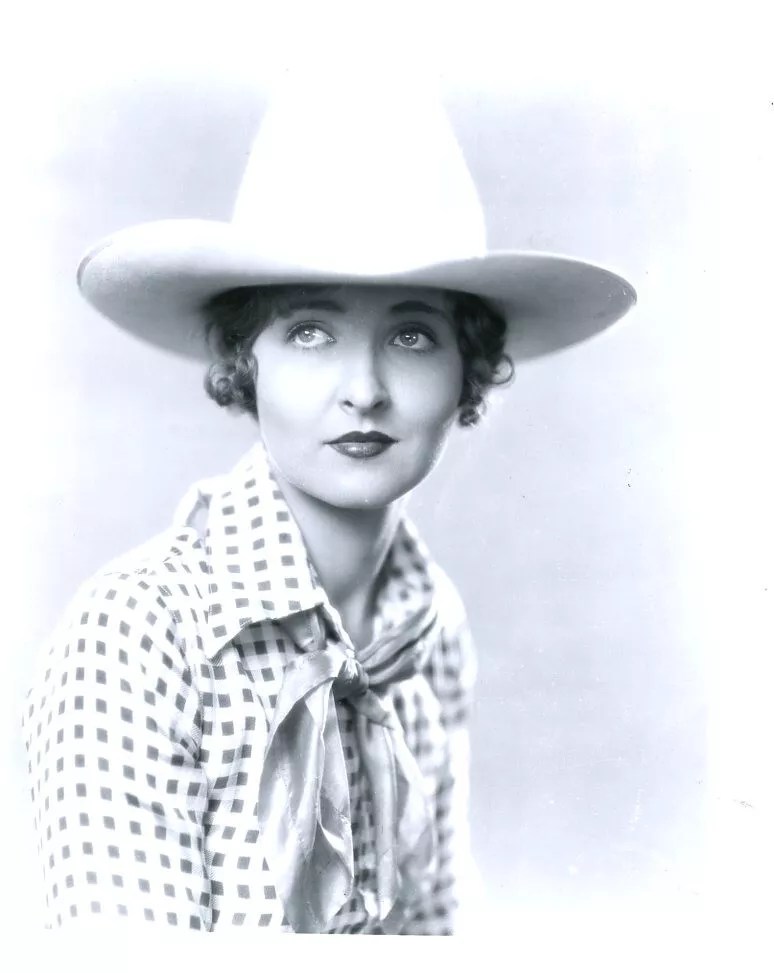
One day I was going through a scrapbook of photographs taken in the 1920s and came across this image.

Well, this just stopped me in my tracks.
Who was this woman, and why was she dressed like that? I looked through the documentation that came with the photo: her name was Gladys McConnell, and she had appeared in a silent movie called The Devil Horse which was filmed at the Morris Ranch, a small dude outfit about 18 miles from Cody.
Gladys looked so confident and comfortable in her western clothes. I couldn’t take my eyes off the photo, and I ordered a copy to be published in my book. Over the last few years, when I’ve had time, I’ve done research on Gladys, but finding information on silent movie stars is not easy. There’s a lot of “according to some people” and “the story goes…”. But here’s what I came up with.
Gladys McConnell was born on October 22, 1905, in Oklahoma, and at some point her family moved to Los Angeles, after spending time in Portland, Oregon. She graduated from Hollywood High School in 1923 and had already decided to become an actress. Her sister Hazel had been making the rounds of screen tests at the movie studios and Gladys supposedly told a casting director she was good with horses and wanted to appear in westerns.

She did make a few short films, possibly in 1923 while she was still in high school. Then, in 1925, she got a big break. She was hired by Hal Roach Studios as the female lead in The Devil Horse. She had formidable co-stars.
Yakima Canutt played the main character. Described in newspaper copy as a “famous horse wrangler, bull dodger and all around rodeo winner,” he was also the greatest stuntman in Hollywood history, and I will arm wrestle anyone who disagrees with me. I refer you to the movie Stagecoach.
Her other co-star was a celebrated horse named Rex, who already had top billing in a number of films whose titles reflected his personality, such as Black Cyclone, and The Law of the Wild. He was sometimes called King of the Wild Horses. According to a press release, anyone who planned to act in a movie with Rex had to spend time with the horse because “…he is given to taking violent dislikes to people at sight,” and if he didn’t like the actors, they couldn’t work on the film. Which was apparently close to the truth.
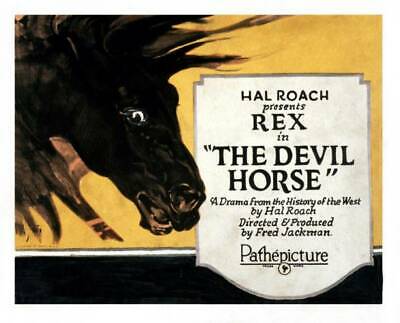
But Gladys made the cut. “Rex passed approval on Gladys McConnell, a beauty who is an expert and fearless horsewoman.” And of course, so did Yakima Canutt.
The plot of The Devil Horse goes like this (and with this kind of language): A boy is captured by Indians when they massacre his family, and while he lives with them, he befriends a wild colt. He escapes from the Indians but years later as an adult he (Canutt) is recaptured and sees that the colt has become the tribe’s killing “Devil Horse.” But the horse remembers the kind former captive, helps him escape, and also helps save the love interest (McConnell).
One interesting fun fact about the script is that it was co-written by Hal Roach and Stan Laurel, of Laurel & Hardy fame. The duo would be introduced to the world by Hal Roach himself in 1927.
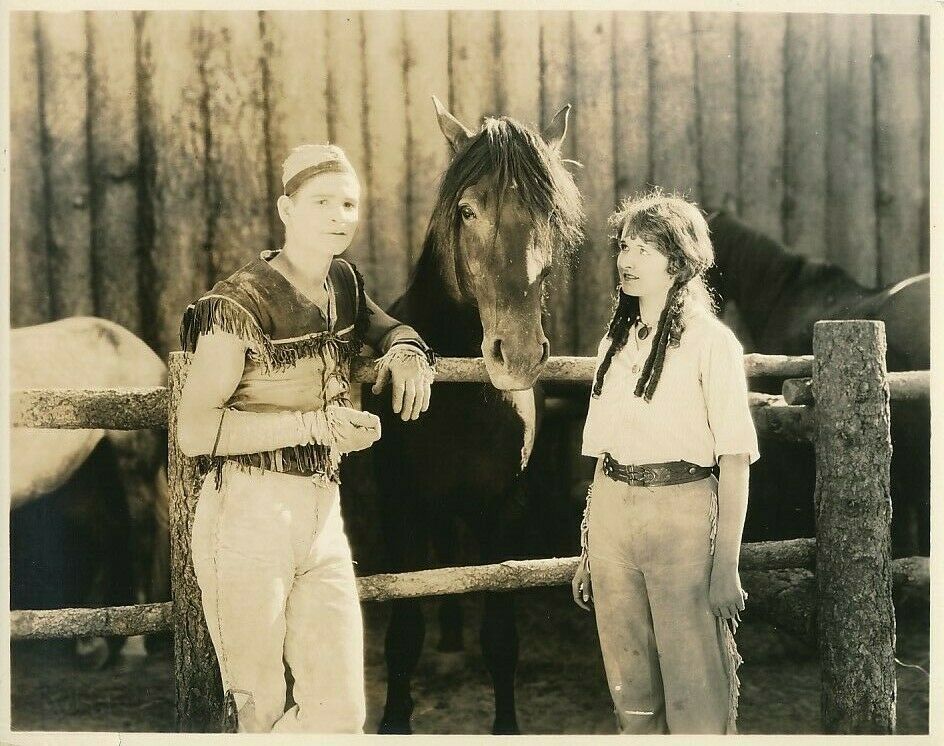
The crew, props, director, and stars arrived in Cody in early August of 1925 and filmed at and around the Morris Ranch for about a month. It was a “pioneer” dude ranch in the area, run by the popular Fred Morris.

The Devil Horse crew went to other western states, and the movie was released in September of 1926. Nearly a century later, in the summer of 2022, I went to Cody on my book tour and got the chance to see where it was filmed. Mack Frost, digital scanning and printing genius at the Buffalo Bill Center of the West, took me and my friend Colleen on a tour of the former Morris Ranch, and other equally beautiful areas. I recognized some of the scenery from the film, which was really a treat.

Gladys went back to Hollywood to film Elsie in New York in the fall of 1925, and then began work on A Trip to Chinatown, with famed Asian-American actress Anna May Wong. In 1927 the Western Association of Motion Picture Advertisers picked her as one of their thirteen yearly “Baby Stars,” which meant that she was “…promising material for future stardom.” She then filmed more westerns, including Parade of the West with Ken Maynard in 1930.

I could write so much more about the rest of Glady’s life, which included leaving her film career, becoming an aviator and meeting Amelia Earhart, getting married, having two children, getting divorced, traveling to Cuba, London, and New York, and watching her granddaughter, Jennifer McAllister, follow her into acting. Gladys passed away on March 4, 1979 and is buried at Forest Lawn cemetery in Glendale, California.
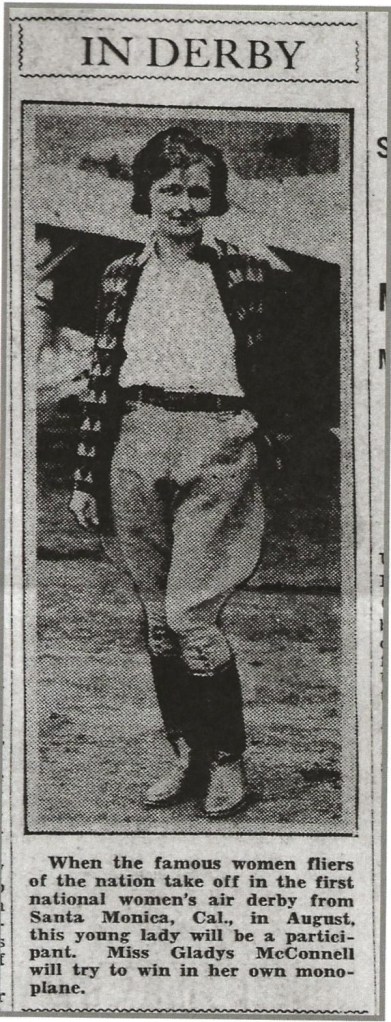
This Derby took off in 1929.
But I want to go back to that photo in the library, because I have to talk about Gladys’s clothes.
The image is obviously a publicity still, but she’s not in the costume she wore in the film. Does that mean this is how she dressed when she wasn’t on camera? Take a look at what she’s wearing.
Her white blouse and vest are pretty simple, but she’s also in cuffed jeans and a pair of gorgeous cowboy boots I would pay good money to own. She holds the cowboy hat like she owns it. All of that would have been western enough, but then someone sewed what looks like a piece of beaded or embroidered leather along the outseam of the jeans.
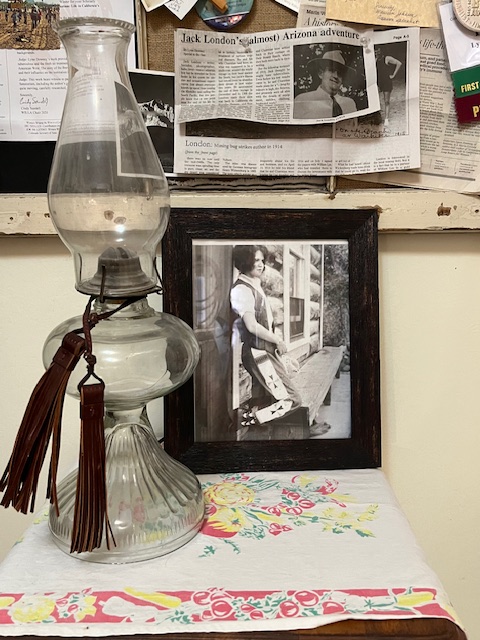
I would also pay good money to know how much of this outfit was hers, and how much of it director Fred Jackman told her to wear. But no matter what the answer is, she is at home in these clothes, and that’s what struck me, and that’s why I have a framed copy of the photo on a table in my office.
Gladys McConnell personifies the generation of female film stars who shone in the silents and early talkies, but when they quit acting, their work was forgotten, except by film scholars. It enriches all of us to know about these women. I’m so grateful to the McCracken Research Library for acquiring this photograph. My life wouldn’t be the same without Gladys in it.
 Tumblereads: A New Twist on the Old West
Simply wonderful information!
I was happy to see that she was casting a film with Anna May Wong. As it happens, I just finished reading the biography about her.
Cheers!
Janet
LikeLike
Thanks, Janet! Was that book “Daughter of the Dragon”? I read that too, I really enjoyed it.
LikeLike
An amazing woman (women?)
LikeLike
Thanks!!!
LikeLike