
Fred W. Loring, Boston-born writer, 1870 graduate of Harvard, and enthusiastic member of Lt. George Wheeler’s 1871 western expedition, died on this day in 1871, victim of a stagecoach attack in Arizona commonly called the “Wickenburg Massacre.”
I prefer to think about how much life he crammed into his twenty-one years, rather than his death. So on this anniversary, here’s a story about Fred that will give you a flavor of who he was.
He was a popular poet in his early years at Harvard. He was also the youngest editor of the student newspaper, the Harvard Advocate, and a fellow editor once said he was the “…best poet and wit in college.”
In 1868, Fred wrote parodies of famous poets for a series called “Some Poetical Molecules.” The editors of the Advocate explained in an introduction that they were tired of the “anathemas” hurled at the poems published in the magazine. So, they sent out a circular to the leading poets of England and America, offering to print any “poetical efforts of your youthful days,” to encourage the equally youthful poets of Harvard.
It was, of course, a joke. Which Fred wrote. The piece went on to describe how eagerly the great writers grasped at the opportunity to appear in the magazine. The editors were so touched they decided to award a sewing machine to the author of the best verses, to be paid for by funds that various merchants owed The Harvard Advocate.
Sadly, no contribution was good enough, and the bills weren’t paid, so the students couldn’t buy the sewing machine. After this hilarious introduction, the issue included six poems, selected from the enormous number of articles forwarded from “…the rising light of American literature.”
Fred wrote all the poems, and parodied everyone from Walt Whitman to Henry Wadsworth Longfellow. The Molecules were so popular he wrote another set in 1869, this time skewering Robert Browning, among others.
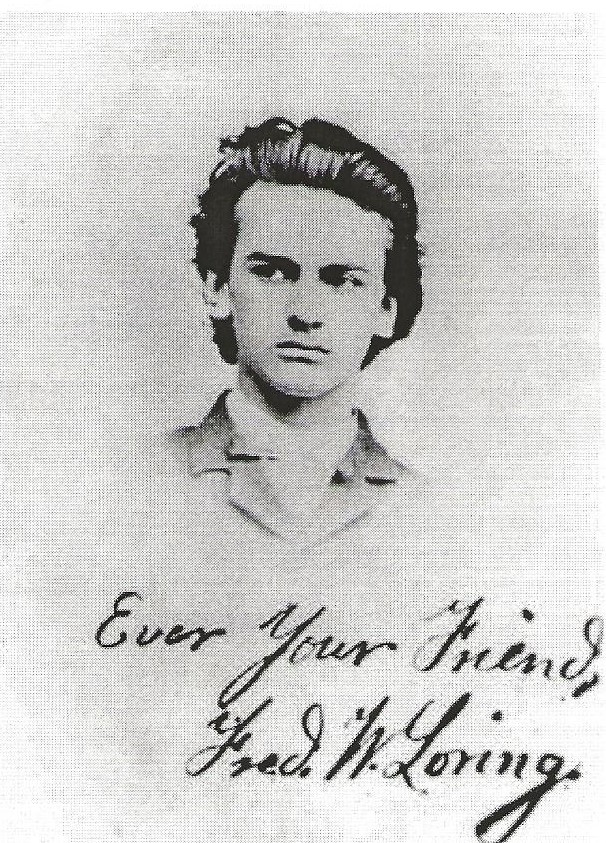
Fred continued to write poetry for the rest of his short life (along with journalism, short stories, and a novel), and one of my favorites is a verse he penned in 1868, titled “A Legend of Harvard: Thomas Sargeant.”
Set in the year 1674, the hero of the piece is thrown out of Latin class one day when he shouts “Damn!” in response to a professor who criticized his attitude toward Virgil. The scandalized college faculty and President decide that Thomas must be suspended, whipped, and fined for this breach of college rules.
Despite the serious subject matter, Fred’s verses are light-hearted, and after describing the whipping (in the library!) he writes:
He went in white and red by starts/He came out various colors.
Tom Sargeant leaves the campus and never returns, and the poem ends with the first-person narrator saying:
But often when on pallet hard
Sweet sleep in vain I’m shamming.
I hear strange noises in the yard
And think his ghost is damning.
He might look serious in his Harvard photographs, but on paper Fred Loring was the wit who always charmed his friends. And his biographer.
 Tumblereads: A New Twist on the Old West
Hi Lynn I trust you are well and I think this would be a great story a story that needs to be heard as well as read… And I like this and I passed it on to many of my friends and your friends and it went as followsâ¦
I’m sure you all know Lynn D but more and more you people need to come together and start broadcasting as well as bookcasting⦠Indian 2026 I’m gonna try and help all of you people pick up the sticks and use both books broadcasting and performances to sell more books have more fun and make more money because we now live in the performance economy.
All the best
Stan
LikeLike
Thanks Stan, as always!
LikeLike