I “retired” as the Levi Strauss & Co. Historian ten years ago, but my time there continues to spill over into the research and writing I’m doing now. (Which is why “retired” isn’t really the right word.)
When I was researching my book American Dude Ranch: A Touch of the Cowboy and the Thrill of the West, I read about a woman named Helen Herford. Born in 1887, she grew up on the family ranch on the Musselshell River near Billings, Montana. Her family was well off and sent her to schools in Massachusetts and Germany, but she was a rancher at heart. Around 1929 she and her cousin Helen Underwood Wellington opened the Swinging H Dude Ranch near Limestone, south of Billings.
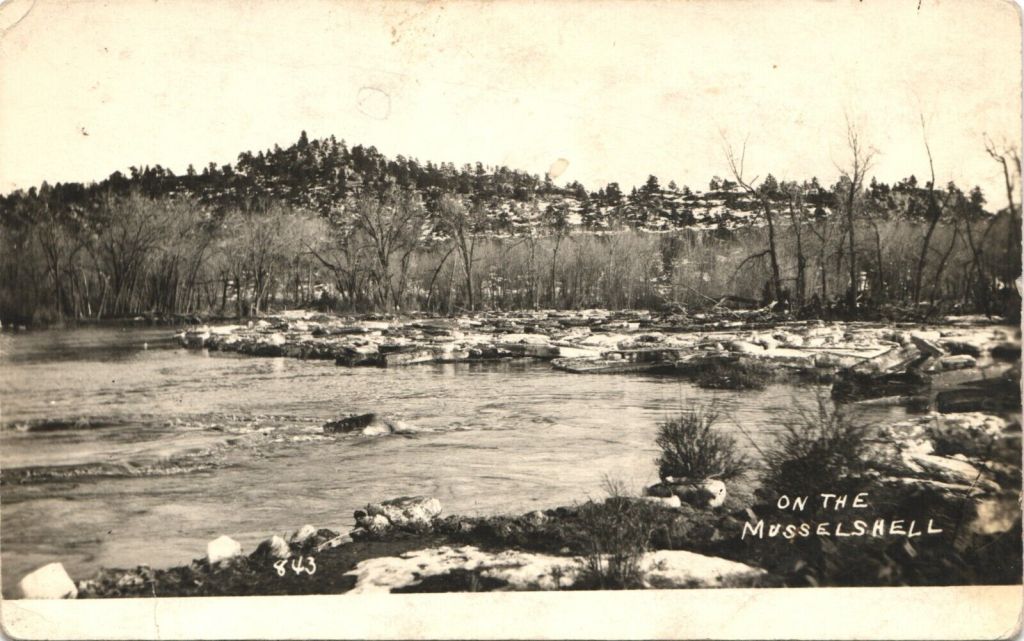
I discovered that Helen’s personal papers were in the Archives and Special Collections division of the Montana State University Library. The finding aid to her collection was on the library’s website, so I scrolled through the document and stopped short when I read this in the description of the Ranch Operation Files: Levi Strauss & Company.
Huh?
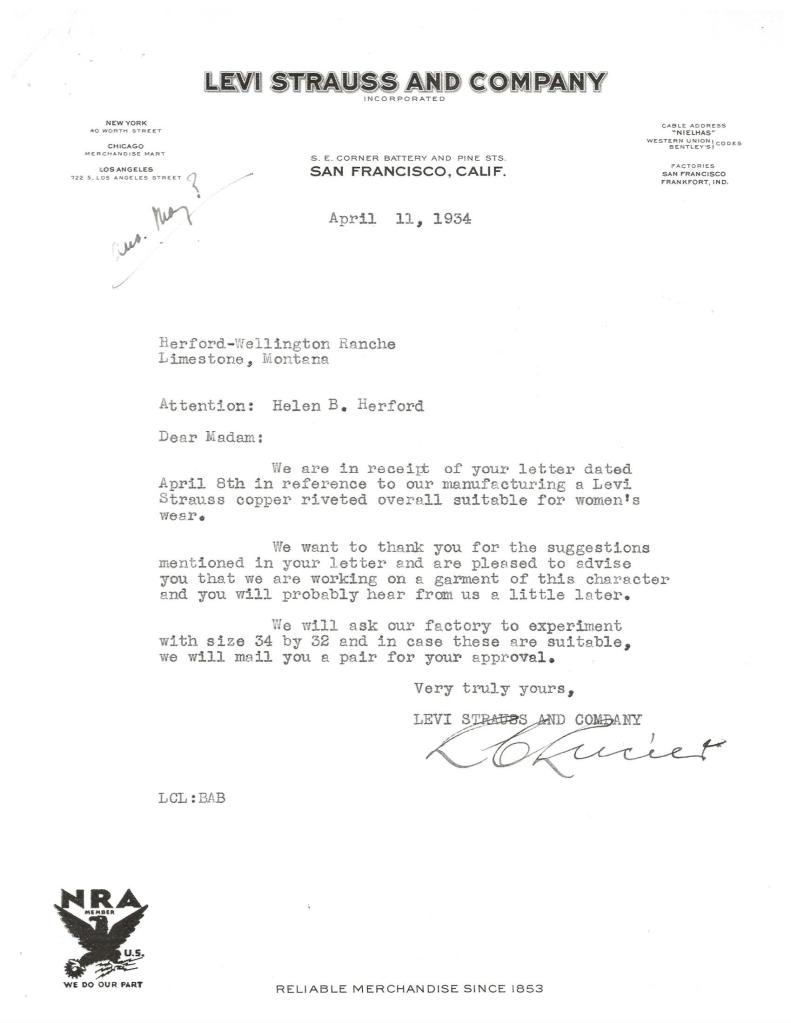
I emailed the archivist, and he told me there was a small collection of letters from Levi Strauss & Co. to Helen dated 1934-1935. He sent me a scan of one of them, and it was easy to figure out why Helen had written to LS&Co.: she wanted them to make jeans for women.
Her timing was perfect. The company was already at work designing Lady Levi’s, the first jeans made specifically for women, and which at the time were called “overalls.”
I couldn’t travel to Montana to see Helen’s archives in person, so I paid the library to scan the entire collection, including the Levi’s letters. And what a treat they are.
Chris Lucier was the company’s National Sales Manager (and the man who would come up with the idea for the iconic red Tab in 1936). This is the first letter he wrote to Helen, and they kept up a correspondence about Lady Levi’s for the next year.
Lady Levi’s were introduced to the public in July of 1934, but Lucier mailed Helen a pair right off the factory floor in June, even before they were placed in retail stores. She wrote back and sent him a review of the pants, and though that letter hasn’t survived, we have Lucier’s response.
If you find the overalls sent to you will not be suitable in that the crotch is too deep and the waistband too high, we will be glad to change these dimensions for you and send you another pair which will give you a more perfect fit. You can be sure we appreciate your interest shown in the development of our women’s overall.
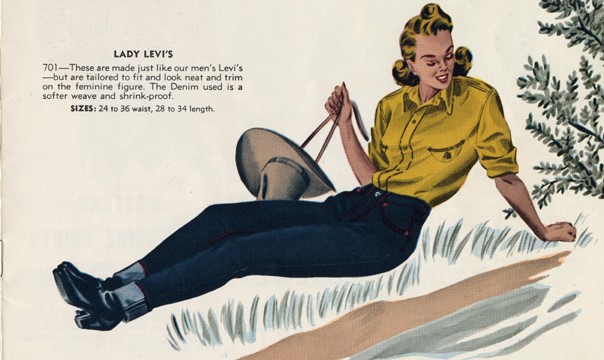
The men’s 501 jeans had both belt loops and suspender buttons, and most men cut the buttons off so they could use a belt. Helen had suggested to Lucier that the women’s jeans not have suspender buttons at all. In a letter from August 8, 1934 he said:
We note your remark respecting the suspender buttons and are pleased to state that the ladies Levi is made without buttons on the waist band.
Helen’s archives at Montana State University have one of the letters she wrote to Levi Strauss & Co. Dated November 17, 1934, she had a question about the size of jeans they sent her. She ended her letter by saying:
Have heard much praise for the women’s overalls and only one complaint. That they have not as many buttons on placket as men’s!
In other words, Lady Levi’s were also a button-fly product and Helen, who had obviously worn men’s Levi’s before, thought that ladies should get the same number. (She seems to have had a thing about buttons.) Lucier’s final letter in the archives is from April 5, 1935, and he says:
The criticism on the lack of buttons on the fly will be taken care of by us immediately and we thank you for informing us of this criticism.
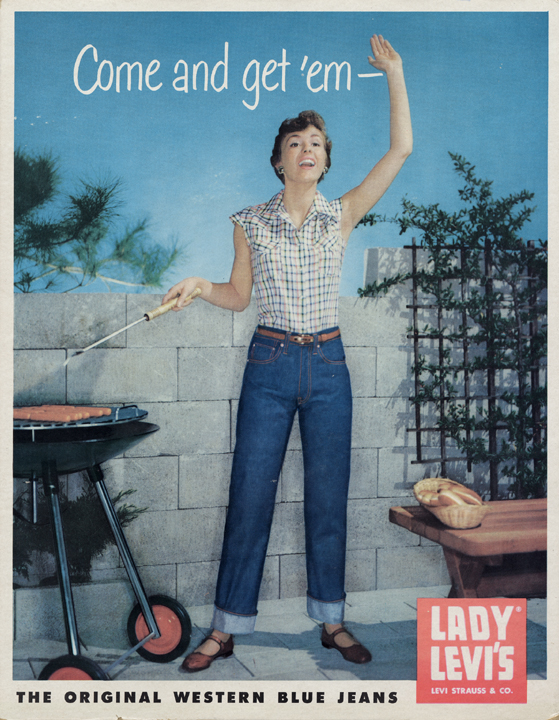
(It’s been a while since I saw a pair of 1930s Lady Levi’s, but I’m pretty sure they have the right number of buttons. In the mid-1950s the jeans were fitted with a zipper instead.)
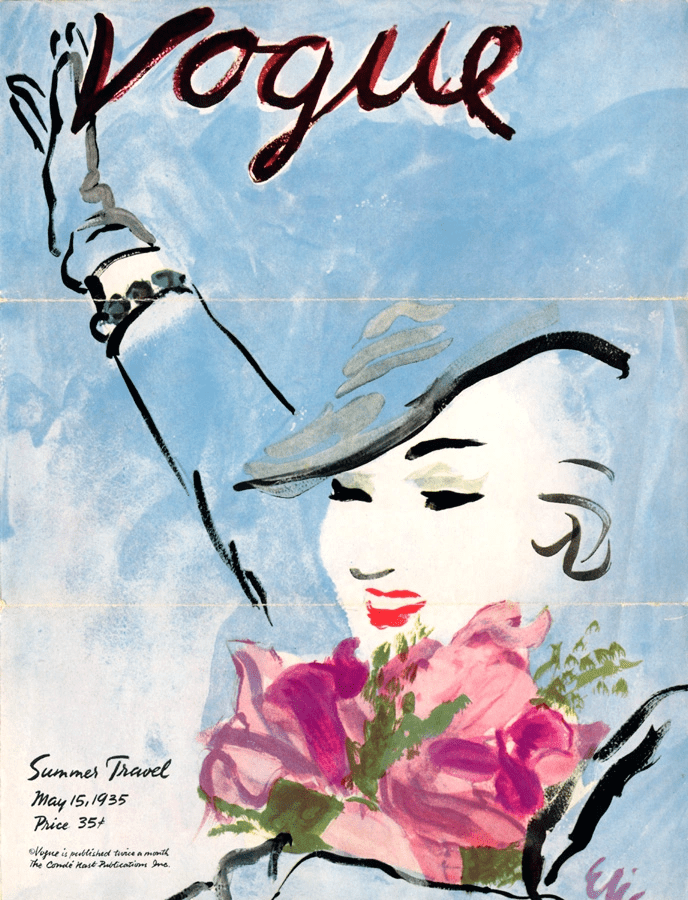
The May 15, 1935 issue of Vogue magazine included a long article about dude ranching and the proper clothes for dudines to wear. Just a year after their introduction, Lady Levi’s were the “overalls” of choice.
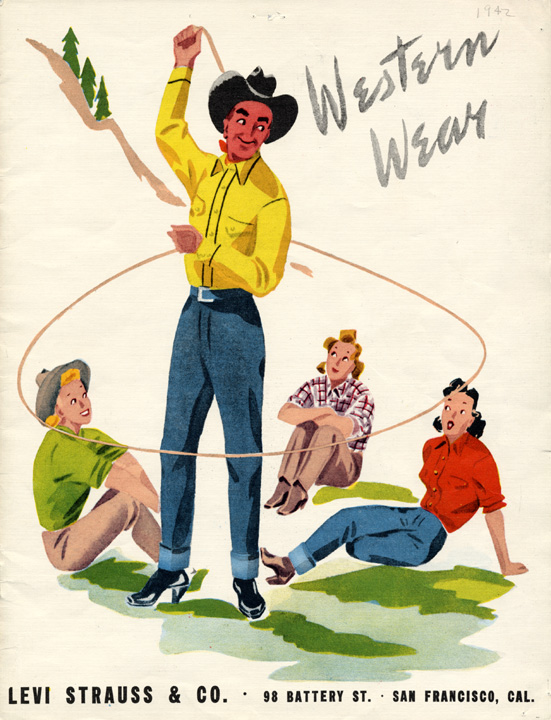
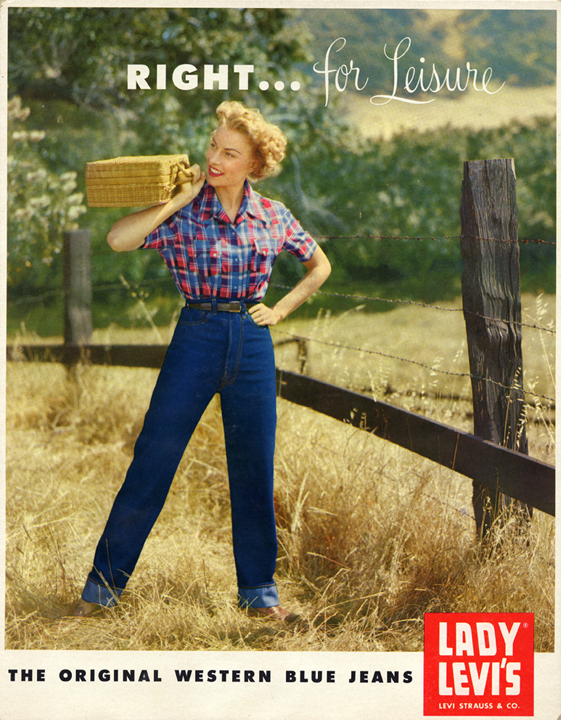
Lady Levi’s were part of the company’s Western Wear line until the 1960s, when the new crop of teenage denim wearers inspired the company to add new flavors of jeans to the collections, and call them Levi’s For Gals.
I love this whole story because of the way my denim and dude ranch worlds come together. And I also love how the company listened to a woman from a remote Montana dude ranch when it was designing the world’s first jeans for women.
Letter and quotations courtesy Archives and Special Collections, Montana State University Library. Levi’s images courtesy Levi Strauss & Co. Archives.
 Tumblereads: A New Twist on the Old West
More buttons on the fly?? What was she thinking? They are are the equivalent to putting a combination lock on a toilet lid.
LikeLike
LOL!!!!
LikeLiked by 1 person
Checked my collection of early Lady Levi’s. Sure enough, there are 3 fly buttons on the 1934 model and 4 fly buttons on the 1937 model! Now I know why. 👏👏👏🙏🙏🙏👖👖👖
LikeLike
Love it! Thanks, Dean.
LikeLike
Hi Lynn, I forgot to get right back to you to thank you for this most recent post, quite enjoyable. I enjoy each and every read that comes my way, thanks for all your effort!
>
LikeLike
Thanks, Greg!
LikeLike